


Differences between force and pressure measurement
 Force and pressure are two distinct but related physical quantities. While both impose stress on a surface, they differ fundamentally in their definition, units, and measurement methods. Understanding this difference is crucial for selecting the right sensor for different applications.
Force is a vector quantity that describes a compressive or tensile force acting on an object. According to Newton's second law, it is the product of an object's mass and its acceleration (F=ma). Simply put, force is the total mechanical stress acting on a body. It is measured in units such as newtons (N) or pounds-force (lbf).
Pressure is a scalar quantity that describes the force acting perpendicularly on a surface per unit area (P=F/A). It is a measure of how concentrated the force is on a specific area. It is measured in units such as pascals (Pa), pounds per square inch (psi), or bars.
The science of measurement
Force measurement with a load cell
A load cell converts a force into an electrical signal. The most common type, which Interface specializes in, uses strain gauges . A strain gauge is a sensor whose electrical resistance changes in response to mechanical stress (deformation). Here's how it works:
- A metal spring element inside the load cell is designed to deform predictably when force is applied.
Strain gauges are precisely glued to this spring element. - When the applied force deforms the element, the strain gauges stretch or compress.
- This change in the length and cross-sectional area of the strain gauge wires changes their electrical resistance.
- The strain gauges are typically arranged in a Wheatstone bridge circuit. This configuration is highly sensitive to small changes in resistance and provides a stable, temperature-compensated output voltage that is directly proportional to the applied force. The output signal is a direct measure of the total mechanical stress on the load cell.
This method is ideal for force measurement because the load cell design is intended to capture all the deformation caused by compression or tension, regardless of how it is distributed across the surface of the sensor.
Pressure measurement with a pressure sensor
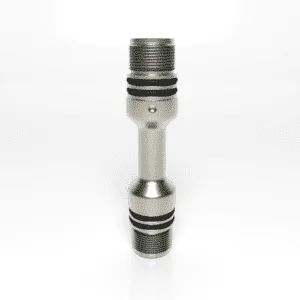 While some specialized Interface load cells, such as the IPCD, are designed to measure pressure by converting the force acting on a diaphragm into an electrical signal, most pressure sensors are not load cells. pressure compensated borehole load cell (IPCD) from Interface enables accurate measurement of tension conditions in vertical and horizontal wells. This solution for the oil and gas industry replaces wet load cells with a maintenance-free product.
A typical pressure sensor uses a diaphragm that deforms under the influence of the pressure of a fluid.
- The fluid's pressure acts on the surface of the diaphragm.
- This pressure causes the diaphragm to deflect.
- The amount of deflection is proportional to the pressure.
- A sensing element, such as a strain gage, a capacitive sensor, or a piezoresistive element, measures this deflection and converts it into an electrical signal.
The key difference is that the sensor's design is optimized to detect the uniform force distribution of a fluid over a specific, known area (the diaphragm). This allows the sensor to calculate the pressure (P=F/A) directly from the measured displacement.
Network to support you in selecting the right solution
Many Interface customers have projects and laboratories where force and pressure are measured in various testing applications. To ensure you get the right solution, our team of experienced representatives and distributors worldwide works closely with our customers to offer the Interface force measurement solution best suited to your specific project. If you need a pressure sensor, our sales network can also help you find the best product for your requirements.
Interface offers a wide range of instrumentation solutions that work in conjunction with pressure and force sensors. For example, our 9870 high-speed, high-performance display unit with TEDS support accurately measures and graphically displays load, pressure, and torque values.
Illustration of the measurement of force and pressure
Measuring the clamping force on a vice
Imagine a manufacturing process in which a robotic arm uses a vise to clamp a part for machining. The quality of the final product depends on consistent clamping force, not consistent pressure.
Challenge – If you were to use a pressure sensor, you would place it between the jaws of the vise and the workpiece. The sensor would measure the force per unit area. However, if the workpiece shifts or the contact area changes slightly (due to an uneven surface or a small particle of debris), the measured pressure value would change, even if the total clamping force exerted by the vise remains the same. A lower pressure value could falsely cause the system to increase the clamping force, potentially damaging the workpiece.
Solution – A load cell is mounted directly on the jaw of the vise, aligned with the clamping action. The load cell measures the total force applied, regardless of the contact area. If the part shifts or the contact area changes, the load cell output remains stable because it measures the total force. This ensures that the part is clamped with exactly the force required for a high-quality result, preventing damage and maintaining process integrity.
Measuring the force of an actuator
In automated assembly, a pneumatic or hydraulic actuator is often used to connect two components. The crucial measurement parameter is the total force exerted by the actuator to ensure a correct and secure fit. Read more: Actuators and sensors combine their strengths in test and measurement technology.
Challenge – Using a pressure sensor to measure the fluid pressure in the actuator cylinder seems like a good idea at first glance, as this pressure is directly related to the force generated by the actuator. However, this is an indirect measurement. The actual force exerted can be affected by friction within the cylinder, seal wear, or temperature fluctuations—all factors that a pressure sensor in the cylinder cannot account for. The measured pressure value may be high, but the actual force exerted on the parts may be less than required.
Solution – By attaching a load cell to the end of the actuator's ram, you can obtain a direct and highly accurate measurement of the total force exerted on the components. This load cell output reflects the actual force applied, accounting for all system inefficiencies. This ensures that each press operation is performed with the required force, ensuring reliable and consistent assembly and enabling precise quality control.
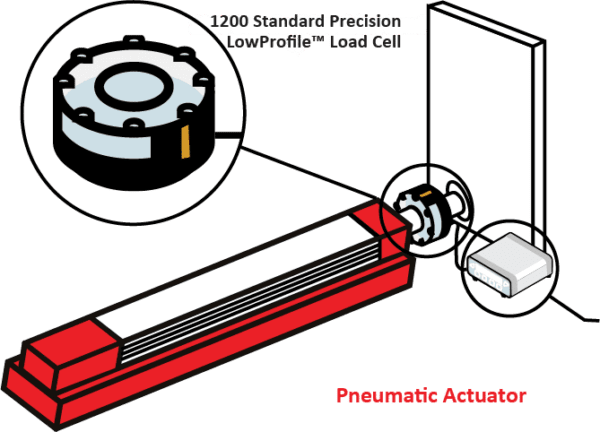
Use Case for Pneumatic Actuator Seal Pressure Testing: A company needs to ensure that the lip seal of its pneumatic actuator withstands varying pressure loads. Interface suggests conducting a fatigue test using its 1200 Standard Precision LowProfile™ force transducer . The 1200 is installed externally on the pneumatic actuator, where various pressure loads are measured. The test continues until the pneumatic actuator is disassembled. Precise force results are captured using the calibratable 9840 multi-channel load cell indicator . Read the use case.
These examples clearly demonstrate that while pressure is a measure of the force acting on a surface, in many real-world applications, the total force is crucial. A load cell is the optimal tool for these tasks because it is designed to measure this total force directly and reliably, regardless of its distribution.
TIP: For a specific review of your application, please contact our application engineers.
Why load cells are best suited for force measurement
While it is possible to construct a load cell for pressure measurement (as with the IPCD ), load cells are generally used because they are specifically designed and calibrated for the accurate measurement of total force.
Attempting to measure force with a standard pressure sensor is problematic because its output depends on both the force and the area over which it is applied. If the force distribution changes, the sensor's reading will also change, even if the total force remains constant. Therefore, a pressure sensor is an unreliable tool for measuring the total force exerted by a fixed object.
Load cells are designed to detect forces applied at a specific point or along a defined axis, such as our multi-axis load cells. The strain gauges are strategically placed to measure the deformation caused by this total load. A key advantage of a force-measuring load cell is that its output signal does not depend on the precise point of force application (within its design limits) or the size of the contact area. It measures the total magnitude of the compressive or tensile force. Most importantly, load cells are calibrated by applying known weights or forces, ensuring a direct and accurate relationship between the output signal and the total force applied.
In summary, a strain gauge load cell is the most reliable and accurate sensor for force measurement because it is specifically designed to measure the total mechanical load. In contrast, a pressure sensor is designed to measure forces distributed over a known area.