


moment 101
 A moment is a measure of the tendency of a force to cause rotation, bending, or tilting when applied at a certain distance from a fixed point or axis. In force measurement, motion refers to the physical displacement or rotation that occurs when an unbalanced force acts on an object.
Every applied load generates either linear motion, rotational motion, or—if this motion is physically restrained—internal stresses. If a force acts directly through the center of an object, the resulting motion is purely linear. However, if this force is applied at a distance from a fixed point or central axis, a lever arm is created, generating the physical tendency for a structure to bend, tilt, or tip. To accurately measure forces in three-dimensional space, both linear forces and the moments generated by off-center loads must be considered.
Moment versus torque in multi-axis sensors
A moment is the rotational effect that occurs when a force acts at a distance from a fixed point or central axis and attempts to bend, tilt, or tip a structure. Torque is a special case of a moment where the rotational force acts directly along a central axis and twists a component about its central axis.
In a multi-axis sensor, complex loads are resolved into three mutually perpendicular directions. Lateral and vertical linear forces are purely shear or tensile forces along the sensor surface and the central height axis.
Bending moments capture the tilting or inclination forces that attempt to flip the sensor around its horizontal axes. Simultaneously, torque isolates the pure torsional force acting around the central vertical axis. Understanding these combined load directions allows engineers to evaluate the complete rotational and linear stress profile at once.
How torque measurements are used in testing technology
Sensors measure torque by detecting minute strains or compressions in specialized internal metal structures. Instead of evaluating only a single force direction, torque measurements provide test engineers with a complete picture of complex mechanical behavior.
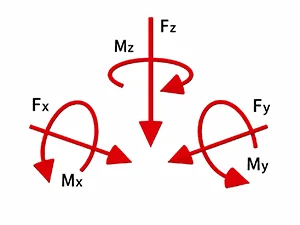 By comparing the rotational bending force with the linear force, engineers can calculate the precise physical location where an off-center force acts on a structure. This ability is crucial for identifying damaging bending stresses that can cause mechanical components to break or fatigue over time—even when pure shear and tensile forces remain within safe operating limits.
Furthermore, moment measurements provide automated control systems with real-time rotation feedback, allowing robotic end effectors to continuously adjust their angle, position, or gripping force when they encounter unexpected off-axis resistance.
TIP: You can learn more about force and torque measurements in the basics of multi-axis sensor technology.
Five technical specifications for sensors for torque measurement
- Channel capacity: The maximum linear force or rotational bending force that a single measuring direction can safely absorb.
- Signal output sensitivity: The electrical signal strength generated by the sensor at maximum rated capacity, measured in millivolts of signal per volt of supply voltage.
- Measurement deviation: The small deviation between the actual applied load and the measured value displayed by the sensor, usually within a fraction of a percent.
- Channel crosstalk (interference): The small, unwanted signal that arises on an unloaded measurement channel when a high force acts on another channel.
- Overload limit: The maximum force or torque that a sensor can withstand beyond its rated load before internal components are permanently deformed or break.
Technical considerations for torque-measuring multi-axis sensors
A moment is the general physical measure of any rotational force that arises when an applied load acts at a distance from a reference point or central origin. Depending on how this force vector is oriented relative to the geometry of an object, a moment can cause a structure to tilt, twist along its central axis, or bend across its cross-section. In multi-axis sensors , moments represent all rotational inclinations in three-dimensional space and provide a complete picture of how off-center or multidirectional forces interact with a physical system.
When designing and selecting multi-axis sensors for torque measurement, the physical interactions between different force directions must be taken into account:
Construction of the internal structure
Multi-axis sensors utilize special internal metal structures to isolate different types of motion. Some designs use a single solid piece of metal shaped to absorb linear forces and rotational moments together, while others stack simpler single-directional sensors within a common frame.
Signal correction calculations
Because a single physical structure deforms slightly under any load, a force acting in one direction can cause minor physical displacements in another direction. To correct for this channel crosstalk, multi-axis sensors use processing algorithms that combine all bridge outputs to extract the actual force and moment values.
Handling combined off-center loads
In real-world operation, forces rarely occur in isolation. An off-center pressure generates both a linear force and a bending moment. Engineers must calculate the combined stress from all acting forces to ensure that the total load does not exceed the sensor's structural limits.
NOTE: A bending moment is a special type of moment that acts perpendicular to the main axis of a component or sensor. Instead of twisting an object along its length, a bending moment attempts to bend, warp, or flip the structure. This creates simultaneous tension on one side of the internal measuring spring and compression on the opposite side—effects that special strain gauge bridges detect to isolate and measure off-axis bending loads.

Interface force and torque sensor models
Interface offers several multi-axis sensor series that simultaneously measure forces and moments.
2-axis sensors
TXY load cells measure forces simultaneously along two axes perpendicular to each other (X and Y) to evaluate biaxial bending or shear forces.
3-axis sensors
- 3A series (3A40, 3A120, 3A160, 3A300) are square 3-axis sensors that measure linear forces along the X, Y and Z axes simultaneously.
- 3AR series These are round 3-axis force sensors for confined installation spaces with low channel crosstalk on all three axes.
- 3AFM series These are 3-axis force-torque measuring devices that measure combined linear and rotational forces in a single unit.
- 5200XYZ is a low-profile 3-axis load cell that measures moment loads along with axial loads to determine center of gravity or misalignment.
6-axis sensors
The models 6A27, 6A40, 6A68, 6A150, 6A225 and 6A300 are monolithic 6-axis load cells that measure all six components simultaneously: three linear forces (Fx, Fy, Fz) and three rotational moments/torques (Mx, My, Mz).
TECHNICAL NOTE: A calibration matrix is required to calculate the forces and moments from the six measurement signals. The calibration matrix defines the relationship between the six measurement signals and the forces Fx, Fy, Fz, as well as the moments Mx, My, and Mz. The use of special calibration matrices ( Matrix Plus ) can improve accuracy and minimize crosstalk for a specific load case.
Examples of momentary applications
Industries ranging from automotive to aerospace use torque measurements for a wide variety of testing applications. Here are a few examples:
#1 – Moment measurement at robot joints to better understand how a mechanical arm extends outwards to pick up an object. The weight creates a strong bending moment in the wrist. Measuring this moment keeps the arm stable.
#2 – Aircraft wing tests require moment measurements. The wind generates lift along the wing surface, creating a bending moment at the wing root of the fuselage. Measuring this bending moment confirms the structural strength.
#3 – Moment measurements at the vehicle wheel are valuable for vehicle testing. When a vehicle drives through a tight curve, the lateral friction acting on the tire, in addition to the vertical weight of the vehicle, generates a bending moment at the wheel hub.
#4 – Human motion studies are used in various medical applications. The evaluation of artificial knee or hip joints requires measuring both the vertical downward force of a step and the bending moments caused by twisting or changes in direction.
The value of the moment measurement
Torque measurements with multi-axis sensors eliminate assumptions by providing a complete, three-dimensional picture of the physical forces. Instead of assuming that forces act along a single straight line, these tools measure linear shear and tensile forces, bending moments, and torque simultaneously at a single measurement point.
Measuring moments creates complete transparency and enables engineers to detect unexpected structural stresses, build safer machines, optimize mechanical designs in terms of weight and durability, and provide automated systems with the precise physical feedback needed to navigate in complex real-world environments.
ADDITIONAL REFERENCE: Dimensions of Multi Axis Sensors