


Force measurement solutions for testing machines
One of the most common applications for force sensors in testing and measurement technology is all types of industrial testing machines. Force and torque data are used in various ways in these types of applications. They can be used in the design phase to optimize a product or component in terms of force input or output. They can also be used as a monitoring device to let users know when a machine or its accessories need to be repaired or replaced. For mechanical engineers, product engineers and users of test laboratory equipment, Interface supplies precision load cells, torque transducers, data acquisition devices and accessories. Machine testing is one of our most important use cases for measurement sensors. Interface has seen a whole range of different applications in different industries. We have compiled some of our application stories that highlight these use cases by describing how force measurement solutions are used in various machines.

Proof of theoretical cutting forces in rotating ultrasonic machining
Rotary ultrasonic machining is a hybrid process that combines diamond grinding with ultrasonic machining to provide fast, high-quality drilling in many ceramic and glass applications. This new process was theoretically proven using computer models. Rotary ultrasonic machining produces forces of very small magnitude. To prove this theory, any load cell used for measurement must be sensitive while maintaining high structural rigidity within a compact, low-profile package. Interface suggests using the 3A120 3-axis load cell in the ultrasonic rotary machine to measure the forces acting on a sample part. With clear signals and minimal crosstalk, applied forces are recorded and stored using the BSC4D multi-channel PC interface module. The 3-axis load cell provides excellent data that helps reveal the relationship between the machine's cutting parameters and the forces acting on the component. With this knowledge, the machining process for new materials and machining can be reliably optimized. Read the full application note on cutting forces of rotary ultrasonic machines.
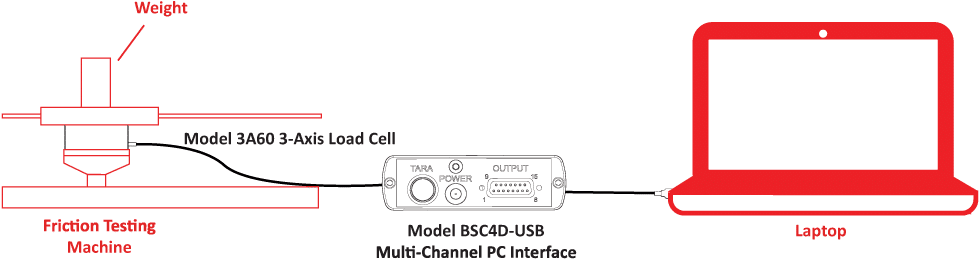
Friction testing machine
A testing lab wanted to replace two single-axis load cells in its friction testing machine with a sensor that could measure force on the x, y, and z axes simultaneously. Interface's 3A60 3-Axis Force Transducer was installed in the existing machine and connected directly to a PC laptop using an Interface BSC4D-USB Multi-Channel PC Interface to monitor and log data in real time. The testing lab was able to simplify sensor setup and improve data collection, creating value for the end customer. Friction testing is a common use case. If you want to know more about this friction testing machine application, go here.

Spring compression testing machine
As part of a machinery and testing equipment upgrade, a customer was looking for a solution to test the performance of their springs in their custom designed spring test bench using a new wireless solution. Interface suggested using the WTS-3XYZ 5200-axis force-torque load cell with three integrated WTSAM-1E wireless transmitters and installing it into the customer's spring compression frame. The WTS-3XYZ 5200-axis force-torque load cell measures the compression force of the spring. The integrated WTS-AM-1E wireless strain bridge transmitter modules wirelessly transmit and display the information to the LCCA Wireless Instrument housing. It can also be programmed to trigger an alarm. You can read more about the spring testing machine here.

Weighing and packaging machine
A food brand wanted to weigh the amount of their snacks that would be automatically distributed into bags during the packaging process. In this case, the packaged potato chips should also be weighed to ensure that the potato chips have the exact weight required by legal regulations. Interface's suggested using multiple SPI Platform Scale load cells and installing them on the potato multihead weigher and packing machine. The SPI Platform Scale load cells were installed in the bracket that attaches the head scale to the packaging machine. The force results of the potato chips were read by the load cells and sent to the ISG Isolated DIN Rail Mount Signal Conditioner, where the customer could control the automated production from their command center. With these products, the customer was able to determine the weight of the potato chips distributed into the bags with highly accurate results. He was also able to control the automated production process using the instruments provided. The company will also use this weighing method for other snacks that require packaging. You can find more information about the packaging machine here.